What Is CPQ?
02/01/2023
14 min read

Last updated September 2026
Configure, price, quote (CPQ) is software that automates how sales teams build product configurations, apply pricing rules, and generate customer-ready quotes. By replacing manual spreadsheets and disconnected approval chains with a single guided workflow, CPQ reduces pricing errors, shortens sales cycles, and protects margins on every deal.
This guide covers how CPQ works, the benefits it delivers across sales, finance, and operations, and the best practices for a successful implementation.
CPQ automates configuration, pricing, approvals, and quote generation for sales
Centralized rules cut quote errors, speed cycles, and protect margins
AI-driven CPQ guides selling, optimizes pricing, and surfaces upsells
Conga CPQ links configuration, pricing, approvals, contracts, and billing
What Does CPQ Functionality Automate?
CPQ functionality automates the three operational steps that determine deal accuracy and velocity: product selection and configuration, pricing, and quote generation. When any one of these steps is manual, errors compound. Invalid configurations reach engineering, rogue discounts erode margins, and approval bottlenecks stall deals before they close.
Each step enforces your business rules, replacing manual intervention with a consistent, auditable process that scales across all sales channels.
Configure
Configuration constrains every product selection to valid combinations, guides reps toward the best-fit solution, and surfaces expansion opportunities before pricing applies:
- Rule-based configurations: Automated constraints validate product combinations, blocking invalid configurations before they reach the customer
- Guided selling and deal scoring: Walk reps through targeted questions to surface the right solution, then score each deal in real time to accelerate close velocity
- Nested bundles: Select from a defined subset of options within a single product view, simplifying complex order configuration without breaking rules
- Product search catalog: Search the full product library from one interface, so every business unit quotes from the same accurate database
- Cross-sell and upsell insights: Trigger automatic add-on recommendations during configuration to expand deal value
Price
Pricing converts that configuration into a margin-protected figure, running it through your discount limits, promotion rules, and subscription schedules without manual input:
- Discounting guardrails: Enforce line-level discount limits and flag violations before quotes leave the building
- Simplified solution selling: Combine one-time purchases, subscription fees, and usage-based charges on a single quote using line-level pricing rules
- Promotion management: Apply eligible promotions based on predefined conditions, with no overrides needed
- Automated subscription management: Calculate recurring charges, co-termed amendments, and renewal ramps instantly
- Contractual agreements: Ensure compliance with contractual obligations with the customer
Quote
Quoting compiles the priced solution into a branded proposal, routes it through your approval chain, and delivers it to the customer in minutes:
- Quote collaboration: Multiple contributors edit bids, compressing proposal turnaround from days to minutes
- Approval workflows: Route non-standard discounts and pricing exceptions through multi-tier reviews based on margin, deal size, or criteria you define
- Quote templates and generation: Produce branded, customer-ready proposals using Microsoft Word templates so your team responds at the pace of every opportunity
How Does CPQ Work?
CPQ works by centralizing product rules, pricing logic, and approval policies on a single platform that connects to your CRM and ERP systems. When a rep opens a deal, CPQ pulls current product, customer, and pricing data from those systems and applies your business rules to every selection in real time:
- Product constraints block invalid configurations before pricing applies.
- Pricing logic calculates the correct rate based on customer tier, contracted terms, and discount authority.
- Approval thresholds trigger automated routing the moment an exception is detected.
- Document templates compile the approved output into a branded proposal without formatting delays or technical involvement.
CPQ functions as a commercial rules engine that enforces your pricing and product strategy across every sales interaction.
Conga uses neural network AI to add a pricing intelligence layer to this architecture, surfacing account-specific recommendations that balance win probability with margin targets. Every completed deal feeds that model with new data, improving recommendation accuracy over time.
Why Businesses Rely on CPQ Software Solutions
According to Custom Market Insights, sales personnel in large organizations spend 20–30% of their time on administrative quoting, approving prices, and revising quotes, work that CPQ automation reduces significantly. That drain reflects a persistent problem: manual quoting leads to pricing inconsistencies, approval delays, and proposals that rely on IT to produce.

Effective CPQ management centralizes product, pricing, and quoting logic so sales teams maintain margin control and close deals faster.
You can deploy CPQ to:
- Improve win rates: Standardize your top performers' playbooks so every rep delivers optimized recommendations, not just those who've memorized the product catalog
- Standardize channel pricing: Maintain consistent rate books across direct and indirect channels to protect contract value and prevent unauthorized markdowns at source
- Eliminate quote errors: Remove configuration mistakes before they reach engineering or procurement, cutting rework and deal delays
- Compress deal cycles: Remove email chains, spreadsheets, and manual handoffs from multi-team quote development, compressing turnaround from days to hours
- Protect margins at scale: Set discount thresholds once so every rep, channel, and deal type operates within them
- Deliver proposals without IT: Generate and send branded proposals without draining development resources or waiting on the programming team
- Track proposal engagement: Know when a prospect opens your quote to follow up at the highest-intent moment
- Integrate contracts and eSignature: Convert approved quotes into contracts and route for signature, removing data re-entry and closing the loop from price to revenue
The Key CPQ Benefits
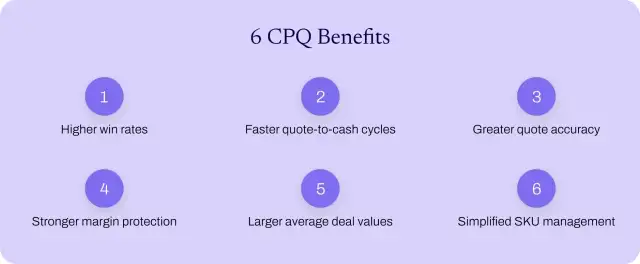
CPQ software improves revenue performance by standardizing how you configure products, apply pricing, manage approvals, and generate quotes. By replacing manual processes with automated business rules, you increase sales efficiency, improve commercial control, and create a more consistent buying experience across every channel.
| Team | How CPQ Helps | Business Outcome |
| Sales | Reps configure accurate quotes in minutes, following the same guided process as top performers | Shorter deal cycles, higher productivity, and improved win rates |
| Operations | Discount limits, approval thresholds, and product rules apply automatically to every transaction | Fewer quoting errors, stronger compliance, and reduced effort |
| Marketing and digital commerce | Self-service channels use the same product, pricing, and upsell logic as direct sales | Consistent buying experiences and increased revenue opportunities across channels |
| Customers | Accurate proposals arrive faster and convert into contracts without re-entering data | Less friction, faster purchasing decisions, and a better buying experience |
Higher win rates
Sales teams lose opportunities when quotes arrive late, contain errors, or fail to address customer requirements. CPQ standardizes proven sales processes across the organization, enabling every rep to build accurate, customer-specific proposals using approved product, pricing, and discount rules.
Guided selling reduces reliance on spreadsheets and tribal knowledge while helping sellers deliver optimized recommendations faster. By removing friction from the quoting process, Advantage CPQ customers have achieved a 30% improvement in win rates.
Turn faster, more accurate quotes into higher win rates with Advantage CPQ
Faster quote-to-cash cycles
Manual configuration, pricing reviews, approvals, and proposal creation introduce delays at every stage of the sales process. A modern configure, price, quote solution automates these activities within a single workflow, reducing handoffs between sales, finance, operations, and legal teams.
Faster quote generation, pricing calculations, and approval routing help organizations deliver customized proposals while buyer intent is highest. With Advantage CPQ, you eliminate the administrative blockage throughout the quoting process, achieving a 38% faster time to quote, accelerating the path from opportunity to revenue.
Learn how to improve your quote process with Conga.
Greater quote accuracy
CPQ enforces strict, preconfigured product compatibility rules, approved pricing structures, and commercial policies directly inside the sales workspace before quotes reach the customer. Reps can't quote incompatible components, non-standard quantities, or outdated service variations.
A rep with two months of tenure and one with ten years quote from the same validated rule set: pricing matches contracted rates, product combinations are valid, and discount levels stay within approved limits. Fewer revision cycles accelerate purchase decisions, protect provisioning teams from costly rework, and build buyer confidence in every proposal your team delivers.
Stronger margin protection
Unmanaged discounting and fragmented pricing practices cause revenue leakage across distributed sales teams:
- Reps exceed their discount authority
- Promotions apply to ineligible deals
- Approvals get bypassed under deal pressure.
The CPQ system applies approved pricing frameworks, regional promotion logic, and contract terms across all channels and reps, flagging exceptions and routing deviations through predefined approval workflows before a quote reaches the buyer. Violations surface for review before proposals are sent, not after contracts are signed in financial reconciliation.
Larger average deal values
Sellers miss expansion opportunities when catalog complexity and deal pressure leave no time for exploration. CPQ identifies cross-sell, upsell, and bundle opportunities at the point of configuration, based on the customer's existing products, entitlements, and historical transaction data, surfacing them during the quote itself rather than as a follow-up after delivery.
Pricing intelligence calculates the most competitive bundle that still meets margin targets, giving reps the confidence to propose complete solutions rather than single-line quotes. Average contract value increases on existing deal volume without additional training or headcount.
Simplified SKU management
Separate product entries for identical items sold under different pricing models increase technical debt, create billing errors, and generate reconciliation work that operations and IT teams absorb across every transaction. CPQ maps a single product to multiple commercial structures for the same SKU, with line-level pricing rules handling commercial variation.
The catalog stays clean, downstream systems receive consistent data, and operations teams maintain a single source of product truth regardless of how many channels, pricing models, or customer segments the business serves.
CPQ Use Cases
CPQ delivers the highest impact for organizations selling configurable products, managing complex pricing structures, or running high quote volumes across multiple channels. The following examples show how CPQ performs across three commercial environments.
Manufacturing
Manufacturers manage highly configurable products, large order volumes, and contract-specific pricing requirements that unstructured quoting can't handle at scale. CPQ automates configuration constraints and supports multi-team quote collaboration, giving operations precise control over contract pricing and discounting.
Use cases of CPQ for manufacturing include:
- Guided selling for configurable products and services
- Support for large quotes with thousands of line items
- Rules-based self-service configuration
- Automated proposal generation
- Cross-functional quote collaboration
- Contract and volume-based pricing
Technology
Technology companies sell subscriptions, services, hardware, and bundled offerings with complex pricing models, co-termed amendments, and multi-dimensional subscription ramps. CPQ validates configurations, automates pricing decisions, and manages recurring revenue scenarios, including mid-term additions and renewals from a single platform.
Technology use cases include:
- Rules-based product configuration and nested bundle management
- Automated pricing and promotion management
- Subscription and recurring revenue management
- Service and maintenance agreements
- Cross-sell and upsell recommendations
- API-driven integration with billing and ERP systems
Organizations with general complexity
Organizations selling combinations of products, services, subscriptions, and usage-based offerings face multi-tier approval structures, data variance between teams, and compliance gaps across sales, finance, and legal.
The CPQ tool standardizes quoting, applies contract-specific terms, and routes pricing exceptions through predefined approval workflows to maintain margin control across every transaction.
Key use cases:
- Guided configuration across multi-category product portfolios
- Automated pricing and discount management
- Proposal and quote generation
- Approval workflow automation
- Contract generation and handoff
- Support for the entire commerce chain
How AI Is Reshaping CPQ Technology
AI is reshaping CPQ technology by shifting it from a rules enforcement tool to a commercial optimization engine. Traditional CPQ applies the rules your team sets. AI-powered CPQ solutions analyze patterns across historical transactions, customer behavior, and market signals to actively improve the quality of every pricing, configuration, and approval decision in real time.
| Capability | Traditional CPQ | AI-Powered CPQ |
| Pricing | Fixed-price books and uniform discount schedules | Account-specific recommendations that balance win probability with margin targets |
| Configuration | Rules-based validation | AI-guided selling with real-time product and bundle recommendations |
| Deal scoring | Not available | Win probability scoring that surfaces at-risk deals before they stall |
| Discounting | Approval-based enforcement | Automated guidance that flags and routes discount exceptions before quotes reach the customer |
| Learning | Static—it doesn’t improve over time | Refines recommendations with every completed transaction |
Smart CPQ embeds this intelligence directly into the quoting workflow, so reps receive guided recommendations at the moment decisions are made. Our system refines its guidance with every closed deal, compounding accuracy across configuration, pricing, and approval decisions over time.
CPQ Best Practices for Successful Implementation
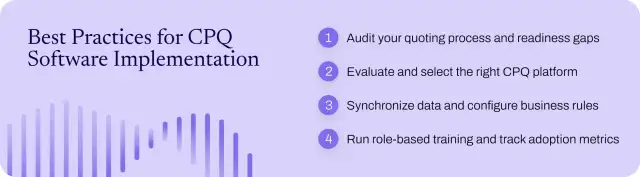
CPQ delivers its full commercial value only when you structure implementation around your revenue requirements. Follow these four practices to reduce deployment risk and accelerate time to value.
1. Audit organizational readiness and uncover revenue leakage
Map your quoting process before selecting a solution. Identify where configuration errors originate, pricing inconsistencies arise, and approval bottlenecks stall deals. Engage stakeholders across sales, IT, finance, and operations to define the full scope of commercial pain points.
Document baseline discount behaviors and contract terms to establish governance parameters. This audit sets your implementation priorities and forms the foundation of a CPQ strategy built around your actual commercial requirements.
2. Select a CPQ platform engineered for ecosystem scale
Evaluate CPQ solutions against your product complexity, pricing requirements, scalability goals, and integration needs. According to Mordor Intelligence, the CPQ market is projected to grow from $3.63 billion in 2026 to $7.55 billion by 2031—driven by AI-enabled configuration tools and shifting procurement norms—and vendor differentiation is accelerating fast.

Legacy on-premises tools offer isolated data control but impose high administrative overhead and development costs on IT. Modern CPQ platforms deliver faster deployment, lower infrastructure cost, and the scalability your business needs to grow.
Use this checklist when evaluating enterprise CPQ platforms:
| CPQ Feature | What to Verify |
| Guided selling | Configurable questionnaires that prevent invalid product combinations |
| Dynamic pricing | Support for volume tiers, regional promotions, and account-specific pricing |
| Approval workflows | Configurable discount thresholds with multi-level authorization |
| CRM/ERP integration | Native connectors to your existing stack (Salesforce, SAP, etc.) |
| Subscription management | Automated renewals, amendments, and mid-term pricing changes |
| Document generation | Branded proposals and contracts generated directly from the quote |
| Security and compliance | SOC 2 and ISO 27001 certification for enterprise data governance |
| Scalability | Multi-channel support for direct sales, partner networks, and self-service |
3. Synchronize data and configure the CPQ system
CPQ generates accurate quotes only when it runs on accurate data. Synchronize customer transaction history, product dependencies, pricing rules, and contract terms from your CRM and ERP before going live. Configure product rules, discount thresholds, approval workflows, and proposal templates to match your actual business logic. Test configurations against real deal scenarios before reps access the system.
4. Build adoption through structured enablement
A well-configured system produces no value if reps don't use it. Run role-based workshops that demonstrate how automated workflows compress proposal turnaround from weeks to minutes. Enable pricing analysts to track margins with visual price-discount waterfalls rather than multi-workbook audits.
Deploy templated document generation, so reps produce branded, compliant proposals inside their daily workspace. Track usage metrics in the first 90 days to identify adoption gaps and address resistance before it compounds.
Connect Your Commerce Chain with the Conga CPQ System
Conga CPQ turns complex product catalogs into accurate, margin-protected quotes. It validates product configurations, enforces pricing rules, and surfaces cross-sell opportunities before a quote reaches the customer. More than 10,000 global customers generate over 46 million quotes annually on the platform.
Our platform connects every stage of your commercial process, from configuration to contract, through a single data source. Your pipeline, orders, invoices, and contracts stay synchronized because they all draw from the same record, eliminating the reconciliation work that slows commercial teams down.
Our CPQ tool integrates with these Conga solutions:
- Conga Digital Commerce: Customers, partners, and sales reps can place orders (or request and present quotes) through a single digital commerce platform, providing a unified and personalized B2B buying and selling experience.
- Conga CLM: Tackle the complexity of customer agreements with an end-to-end contract lifecycle management solution built within Salesforce. Automate highly complex contracting processes that span geographies, multiple departments, and both buy- and sell-side contracts
- Conga Order Management: Get a single source of truth for the entire order lifecycle, including the order release to multiple fulfillment systems. Combined with CPQ, Order Management enables a seamless flow across the entire revenue lifecycle.
- Conga Billing: Automate billing and invoicing management for your entire organization. Bill for blended business models, including subscription services, physical goods, professional services, and usage-based or consumption-based services.
Your commerce chain works best when every link connects. Talk to our sales team to see how Conga CPQ fits your commercial environment.
Put Conga CPQ to work across your entire commercial process
Frequently Asked Questions
-
What is a CPQ tool in SaaS?
A CPQ tool in SaaS is a subscription-based, cloud-delivered application that sales teams access without installing or maintaining on-premises software. It connects to your CRM and ERP via standard APIs, receives automatic updates from the vendor, and scales with users and transaction volume without additional infrastructure.
CPQ for SaaS reduces IT overhead while keeping product, pricing, and quoting logic centralized and up to date across all sales channels.
-
What is the CPQ process?
The CPQ process is a three-step commercial workflow that converts a customer requirement into a finalized quote.
- Configuration validates product selections against business rules, blocking invalid combinations before pricing applies.
- Pricing calculates the correct rate based on contracted terms, discount authority, and applicable promotions.
- Quoting compiles the approved output into a branded proposal, routes it through required approvals, and delivers it to the customer.
Each step enforces your commercial policies, regardless of which rep builds the deal.
-
Can CPQ systems be integrated with CRM platforms?
Yes. Conga CPQ, for example, integrates natively with Salesforce and connects to Microsoft Dynamics and SAP through standard APIs. Our connection pulls customer, product, and pricing data from your CRM into the quoting workflow, so reps configure and price deals without leaving their sales environment. Completed quotes, pricing agreements, and approval decisions write back to the CRM record, keeping opportunity data accurate across both systems.
-
What industries use CPQ software?
The industries that use CPQ software most heavily include manufacturing, technology, life sciences, financial services, and distribution. These sectors share a common need: configurable products, complex pricing structures, or high quote volumes that manual processes can't handle at scale.
- Manufacturing: thousands of line-item orders and contract-specific pricing across large, configurable product catalogs
- Technology: subscription management, bundle configuration, and recurring revenue automation
- Life sciences: compliance-driven pricing, contract terms, and approval workflows across regulated sales cycles
- Financial services: complex product and service quoting standardized across multiple channels and customer segments
- Distribution: volume-based pricing, regional promotions, and multi-tier discounting at scale
-
Why integrate CPQ with contract lifecycle management?
Integrating CPQ with contract lifecycle management (CLM) eliminates the data re-entry and pricing discrepancies that occur when sales and legal operate on separate systems. Conga CPQ connects natively to Conga CLM, so commercial terms agreed during quoting carry over into the contract. The result is a shorter path from an approved quote to an executed agreement, with pricing, product configurations, and contract terms remaining consistent from the first proposal to the final signature.
Related Resources
-
5 sales pain points solved by CPQ automation BlogCPQ5 sales pain points solved by CPQ automation
Every business has a process for configuring, pricing, and quoting products and services. However, many haven't yet considered the transformative potential of a configure, price, quote (CPQ) tool. CPQ could be the key to generating more revenue for your business.12/05/20246 min read -
The Quote to Cash Process in 10 Steps BlogCLMThe Quote to Cash Process in 10 Steps
Discover how to streamline your quote-to-cash (Q2C) process to accelerate sales cycles, improve customer experience, and boost revenue. This comprehensive guide covers every stage—from configuration and pricing to contract management, billing, and renewals—plus tips for finding the right automation solution. Learn how to eliminate silos, reduce errors, and drive efficiency across your CRM and ERP systems.12/01/20259 min read -
The ultimate guide to order-to-cash (OTC): Everything you need to know BlogCLMThe ultimate guide to order-to-cash (OTC): Everything you need to know
Gaining new customers for your business is a big accomplishment that requires cross-functional effort by numerous teams. However, the hard work doesn’t stop when you close the deal or a customer places their initial order. In fact, that’s just the tip of the iceberg, and what comes next can be even more complex.04/01/20235 min read -
Connect and Learn With Peers in the Conga Customer Community BlogCLMConnect and Learn With Peers in the Conga Customer Community
Join 40,000+ peers in the Conga Customer Community—connect, learn, and grow with resources, training, and support to fuel smarter business outcomes.09/30/20266 min read